
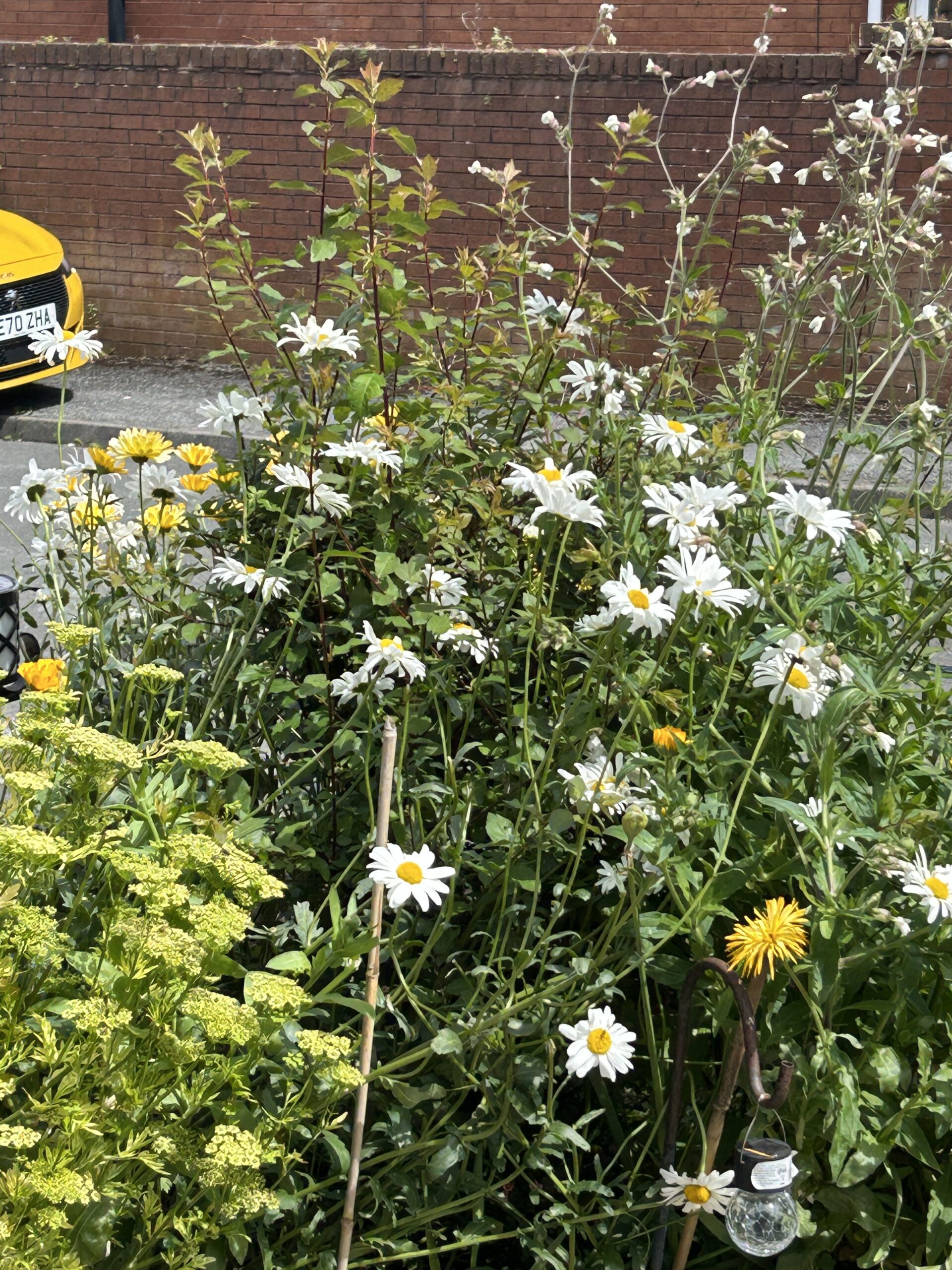
Isn’t it amazing the way some things seem to arrive in waves? Like these wild flowers growing in the front corner of my tiny garden in Heathcote Close, from a packet of seeds I threw out there about a year ago. Last year, there were a few flowers, but this year I have been blessed with this amazing display.
There also seems to be a wave of folk who have decided to finally do something they’ve been thinking about for years, and that is: get some coaching to ‘reduce’ or ‘modify’ their accents. I’m not complaining that they happened to come to me. I’m thoroughly enjoying working with them, encouraging them to think more about speaking clearly than actually changing their accents. Because in spite of what every nation, every culture, every community in the world likes to think, there are no ‘bad’ accents. No ‘ugly’ accents. Just different ones. There will always be speakers of any accent who mumble, or drone in a narrow range, or speak as if their noses are blocked all the time. This has nothing to do with the actual accent.
The problem is, we all grow up – if we grow up in a single language/accent culture – believing that the way we speak is the right way, and everyone else is wrong. I’ve heard my young grandchildren, aged 3 and 4, mocking people who speak differently to them. It’s understandable, but, just as their occasional acts of downright meanness to each other need to be challenged, so does this negative attitude to speech pronunciation.
We all want people to understand us clearly when we have something to say, and it’s hard to listen when the sounds are strange to our ears. But our ears and our understanding are more clever, more adaptable than we think they are. We can tune in to the new sounds, taking time to figure out what they mean, being patient with the speaker, and with ourselves.
So I am absolutely delighted to be working with clients who have highly interesting ideas, concepts and challenges to share with their clients, as well as their neighbours and friends. I can show them how to tone up the muscles they use to articulate their sounds, so that they can be articulated more clearly. They don’t need to change their accents, just speak more effectively. If they are so inclined, they can train to speak with a Standard Southern English accent, and code switch whenever they choose back to their home accent. It’s a skill, just as a ballet dancer can train to be a tap dancer as well if they want to.
More accents, like wild flowers, will flourish when the conditions are right. And who would have thought a madly wet winter followed by a drought and a cold spring would have been the right conditions for this gift of gorgeousness!